
Posted by Rob Whalley
How CAFM/CMMS Will Be Critical to Delivering the UK’s Education Estates Strategy
In February 2026, the UK Department for Education published its long-awaited Education Estates Strategy: a decade of national renewal, setting out a 10-year vision to transform the physical infrastructure of over 22,000 schools and colleges across England.
Backed by unprecedented capital investment — £38 billion between 2025-26 and 2029-30, the highest education capital programme since 2010 — this strategy represents a fundamental shift in how estates are managed, maintained and renewed.
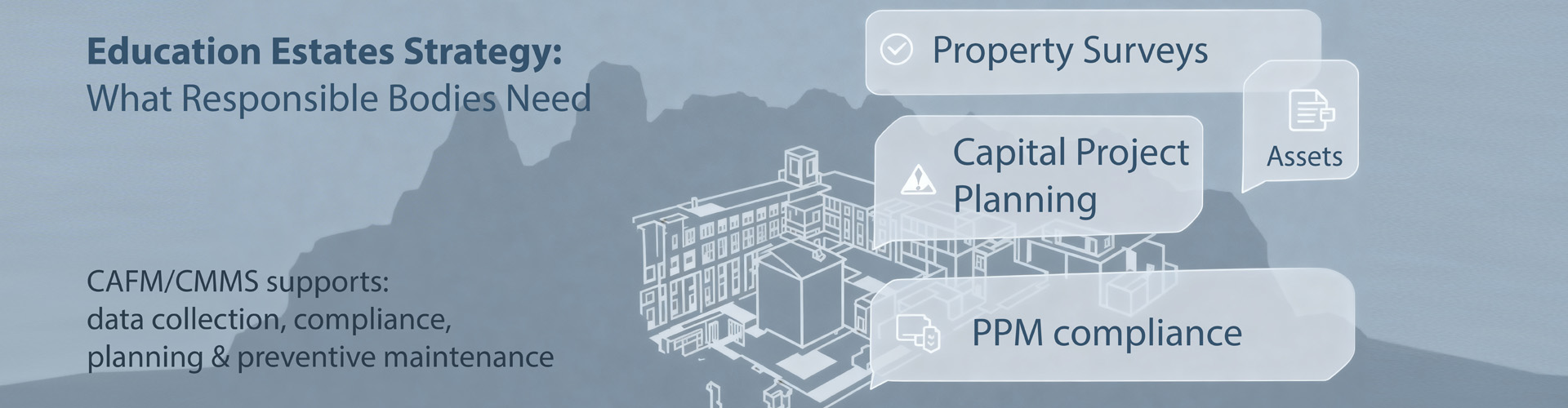
At the heart of this strategy is the move from reactive “patch and mend” repairs to proactive, data-led asset management — an area where a robust CAFM/CMMS platform can make all the difference for Responsible Bodies.
Who Are Responsible Bodies?
In the strategy, a Responsible Body refers to the organisations charged with running and managing estates — from multi-academy trusts and single academy trusts, to local authorities, voluntary aided bodies, dioceses and FE college corporations. There are around 2,800 Responsible Bodies across England’s education estate.
These organisations now face new expectations around strategic maintenance planning, data reporting, compliance and long-term lifecycle management — responsibilities that CAFM/CMMS are purpose-built to support.
1. Strategic Data and Estate Transparency
One of the most transformative changes in the strategy is the emphasis on better data, shared standards and digital reporting:
- A new digital platform, Manage Your Education Estate, launched in February 2026, will centralise guidance, tools, funding information and condition data for Responsible Bodies.
- From Autumn 2026, Responsible Bodies will be required to make annual returns to the Department for Education against the School Estate Management Standards.
- By 2028, data collection and sharing with central government is expected to be more routine and standardised.
CAFM/CMMS platforms are key enablers here — automating asset data collection, condition scores, maintenance histories, risk flags and compliance evidence, to satisfy these new reporting obligations.
2. Proactive Maintenance Over Reactive Repairs
The strategy clearly signals the end of “patch and mend” repairs, emphasising lifecycle planning, condition-led investment and proactive maintenance.
This is where CAFM/CMMS systems deliver high strategic value:
- Planned Preventative Maintenance (PPM): Automatically schedule routine tasks, reducing emergency call-outs and extending asset life.
- Lifecycle Forecasting: Predict capital replacements (e.g. roofs, HVAC, electrical systems) years ahead, aligning with funding cycles.
- Condition Monitoring: Integrate survey data, sensor feeds and inspections into a central platform for risk-led decision-making.
By harnessing digital asset data, Responsible Bodies can justify funding allocations more effectively and optimise estate budgets over the decade ahead.
3. Replacing the Condition Improvement Fund
The Government intends to phase out the Condition Improvement Fund (CIF) by autumn 2028, replacing it with a simpler, data-driven programme that allocates maintenance funding based on evidence rather than competitive bids.
For Responsible Bodies, this intensifies the need for accurate, granular data that CAFM/CMMS can provide:
- Standardised asset registers
- Condition and risk scores
- Cost plans linked to funding buckets
- Digital audit trails for funding applications
Without reliable data, responsible bodies could struggle to access these new funding streams.
4. Capital Programmes and Renewal Projects
Beyond maintenance, the strategy commits to major programmes that will also depend on strong estate management data:
- Nearly £20 billion allocated to the School Rebuilding Programme through to 2034-35.
- A £700+ million Renewal and Retrofit Programme to extend building life and embed climate resilience.
Being able to analyse existing asset condition, forecast renewal needs and model different investment scenarios in a CAFM/CMMS will allow Responsible Bodies to:
- Prioritise projects with the greatest ROI
- Align condition evidence with capital bids
- Track project outcomes against strategic goals
5. Supporting SEND and Inclusion
A noteworthy ambition in the strategy is that every secondary school will eventually have a dedicated inclusion base — spaces designed to support pupils with additional needs.
Delivering on this commitment will require detailed planning, space utilisation analysis and integration into wider estate strategies — all tasks that benefit from CAFM/CMMS tools capable of:
- Space management and utilisation reporting
- Integration with timetabling and access controls
- Condition and compliance mapping across specialist zones
6. Climate Resilience and Sustainability
Climate resilience — including overheating mitigation, flood risk adaptation and net-zero readiness — is embedded into the strategy’s goals.
CAFM/CMMS supports sustainability work by enabling:
- Tracking and reporting on energy performance
- Scheduling maintenance that improves efficiency (e.g. insulation, HVAC tuning)
- Supporting decarbonisation plans with lifecycle costing tools
Why CAFM/CMMS Matters Now
The Education Estates Strategy sets out a decade-long transformation, but the earliest milestones — like the Manage Your Education Estate platform launch and annual returns due from autumn 2026 — are already upon Responsible Bodies.
Without a structured, digital approach to managing assets, maintenance, compliance and reporting, Responsible Bodies risk:
- Falling behind on data standards
- Losing out on funding
- Facing inefficient maintenance cycles
- Being unable to evidence compliance with new Government expectations
A modern CAFM/CMMS platform helps Responsible Bodies turn compliance obligations into operational advantage, driving:
✔ better planning
✔ reduced downtime
✔ clear audit trails
✔ data-supported investment decisions
In short, CAFM/CMMS isn’t just a software choice — it’s a strategic tool to meet the demands of a decade of national renewal and build education estates that are safe, sustainable, inclusive and future-ready.


























Follow us:
GDPR (Data Privacy)
Disclaimer
COVID-19